
Anyone can buy a microphone. Building a podcast worth listening to? That’s where strategy, storytelling, production, and a little Knoodle magic come in.
There are a lot of podcasts out there. Some are brilliant. Some are entertaining. And some sound suspiciously like two people who accidentally left their microphones on during a conference call.
The difference isn’t necessarily the equipment, the budget, or even the person behind the microphone.
It’s having something worth saying. And knowing how to say it.
For businesses, podcasting can be a powerful way to build relationships, establish expertise, and give people a reason to spend more time with your brand. But here’s the catch: a podcast isn’t automatically a marketing strategy just because your company has one.
That’s where a little planning goes a long way.
Your Brand Has a Voice. Give It Something to Say.
Let’s start with the big question: Why would anyone listen?
Not why you want to launch a podcast. Why would someone else willingly spend 20, 30, or 45 minutes listening to it?
Maybe you have expertise your customers can’t find anywhere else. Maybe your industry is full of fascinating people with stories worth telling. Maybe your customers have questions that deserve better answers than another 500-word FAQ.
Whatever the reason, it needs to matter to your audience.
The best business podcasts don’t feel like extended commercials. They offer something valuable: insight, entertainment, perspective, education, or a genuinely good conversation.
And when that happens, something pretty interesting follows. People begin to associate your brand with the expertise and experiences you’re sharing.
That’s thought leadership without having to announce that you’re a thought leader.
Which, frankly, is how it should work.
Podcast Marketing: More Than Just Another Content Channel
A business podcast gives your brand an opportunity that traditional advertising rarely does: an extended, voluntary conversation with your audience.
Nobody is forcing listeners to stay. They’re choosing to.
That makes podcasting particularly interesting for businesses with complicated products, long sales cycles, relationship-driven services, or expertise that doesn’t fit neatly into a 15-second ad.
Think home builders, financial professionals, healthcare organizations, technology companies, and professional services firms.
A podcast can help those businesses:
- Build credibility. Let your expertise come through in real conversations rather than another list of reasons you’re great.
- Create connections. Invite customers, industry leaders, partners, and other interesting people into the conversation.
- Answer meaningful questions. Explore the topics your audience is already researching.
- Humanize your brand. Give people a chance to hear the personalities and perspectives behind the logo.
- Fuel your content marketing. Turn one great conversation into articles, videos, social posts, newsletters, and more.
But none of those benefits happen just because you hit Record.
A successful podcast needs a purpose, a plan, and an audience worth pursuing.
Before You Hit Record, Hit the Strategy Button
At Knoodle, we’re big believers in starting with the why.
Why this audience? Why this subject? Why this format? And perhaps most importantly, why should this podcast exist in the first place?
A good business podcast strategy answers three essential questions.
Who’s Listening?
Trying to appeal to everyone is an excellent way to become interesting to no one.
Define the audience you actually want to reach. What do they care about? What challenges are they facing? What conversations are they already having?
A podcast aimed at homebuilding executives should sound different from one designed for first-time homebuyers.
Different people. Different questions. Different reasons to tune in.
What’s the Big Idea?
Your podcast needs a recognizable point of view.
That doesn’t mean every episode has to cover the same subject. It means listeners should understand what they’re going to get from spending time with you.
Maybe you’re exploring the people changing your industry. Maybe you’re demystifying complex decisions. Maybe you’re bringing together experts who rarely get to have an honest conversation.
Whatever the concept, make it specific enough to be memorable and broad enough to sustain more than three episodes.
What Does Success Look Like?
Downloads are nice. Business results are nicer.
Depending on your goals, success might mean reaching prospective customers, strengthening relationships with existing clients, building a library of useful content, attracting qualified website visitors, or opening doors to new business conversations.
Decide what matters before the first episode goes live.
Otherwise, you risk producing a lot of content without knowing whether it’s doing anything useful.
The Founder’s Hour: Taking Our Own Advice
We could talk about podcasting in theory all day.
But we’d rather show you what we mean.
At Knoodle, we produce The Founder’s Hour, a podcast hosted by Knoodle founder Rosaria Cain that brings entrepreneurs, business leaders, and innovators into conversations about building businesses, overcoming challenges, and making things happen.
The idea is simple: Interesting people have interesting stories. Give them room to tell those stories, and the conversation becomes the content.
Our guests have included John Galante of AE Ventures, discussing innovation in homebuilding; Pat Crowley of One Hope, exploring workforce development and the future of skilled trades; Jim Belfiore of Belfiore Analytics, examining the data behind housing-market decisions; and Dave Alford of the Scottsdale Rodeo Museum, sharing the history and people behind an Arizona tradition.
Different industries. Different personalities. Different perspectives.
One consistent thread: the people behind the businesses.
And while the conversations may feel spontaneous, there’s a lot happening behind the scenes to make them look and sound that way.
That’s where our creative and production teams come in.
Behind the Scenes: Making the Magic Look Effortless
Here’s a little secret about professional podcast production.
The better it’s done, the less you notice it.
When a conversation flows naturally, nobody should be thinking about camera angles, lighting modifiers, editing transitions, or microphone placement.
They’re thinking about the story.
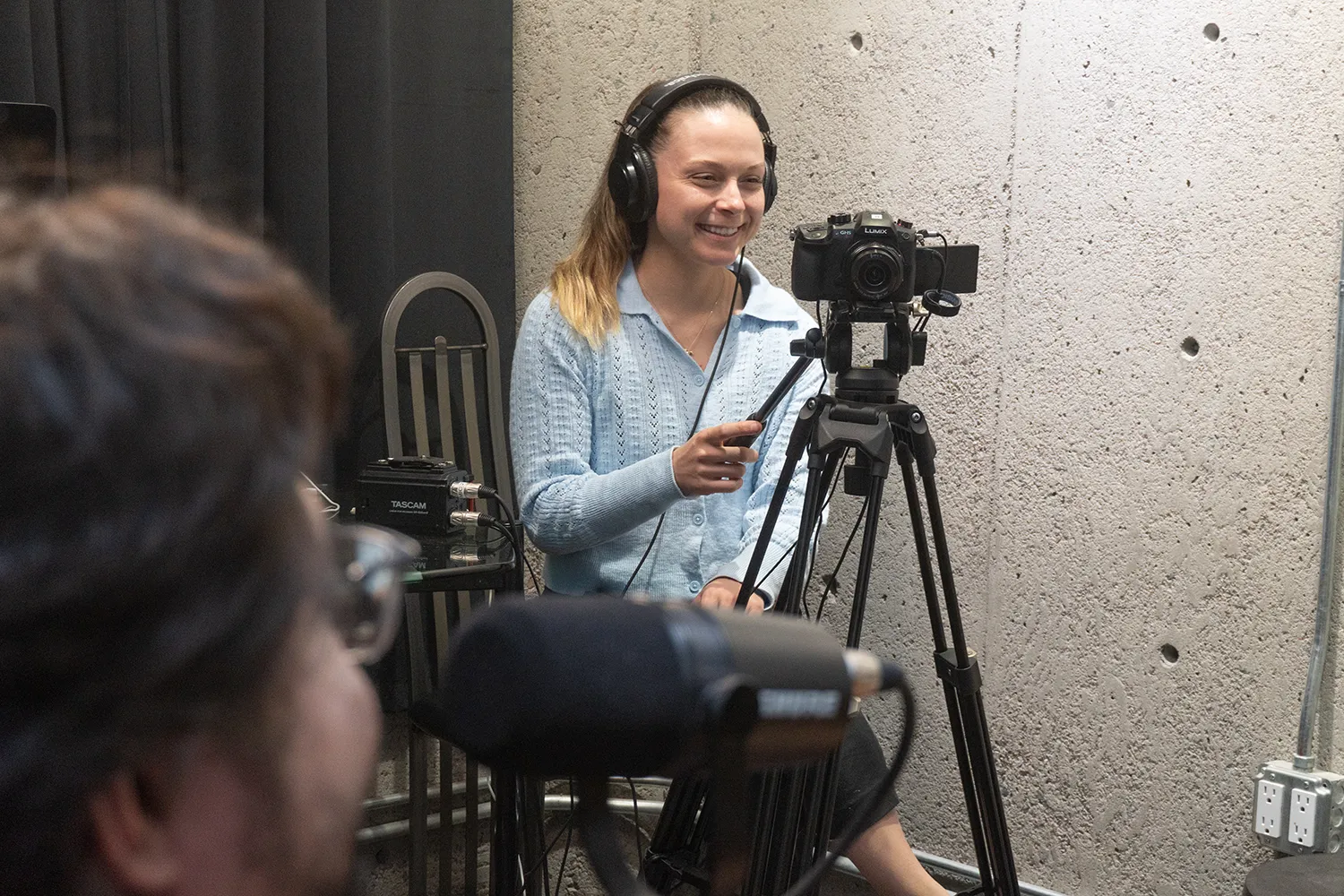
At Knoodle, we’ve built an in-house podcast studio specifically to create that kind of experience for The Founder’s Hour.
And while we love the creative possibilities of professional equipment, every production decision comes back to one question:
Does this make the story better?
Two Cameras. One Great Conversation.
For The Founder’s Hour, our production team uses two Panasonic GH5 cameras equipped with Lumix G 14–42mm lenses.
One camera focuses on Rosaria, our host. The other captures the guest.
It sounds like a simple setup, but that second camera makes a big difference.
Instead of watching one static shot throughout the conversation, viewers experience the natural back-and-forth between speakers. We can cut to a guest sharing an important insight, capture the host’s reaction, or shift perspectives as the conversation unfolds.
Those visual choices help create a sense of connection.
Because sometimes the most interesting part of a conversation isn’t what someone says.
It’s the expression on the other person’s face when they hear it.
Lighting That Flatters. Not Distracts.
Good lighting can make a podcast look polished. Bad lighting can make an otherwise fascinating interview resemble a security-camera recording.
For our studio, we use an Aputure 150 light with a lantern modifier, positioned high and away from our subjects.
The lantern diffuses the light, creating soft, natural illumination and reducing harsh shadows.
The result is a flattering, professional appearance that keeps attention where it belongs: on the people and their stories.
There’s a creative philosophy behind that choice.
We’re not trying to make our guests look like they’re appearing in a big-budget Hollywood production. We’re trying to make them comfortable, approachable, and authentic.
And make them look pretty darn good while we’re at it.
The Editing Room: Where Good Becomes Great
Even the best conversations benefit from thoughtful editing.
Our creative team brings together the camera footage, selects the most effective angles, balances the audio, and refines the pacing.
The goal isn’t to eliminate every pause or make guests sound scripted.
It’s to preserve the personality of the conversation while removing distractions.
We also developed a custom-branded video template for The Founder’s Hour, including consistent typography, graphics, and opening and closing sequences.
Those elements create a recognizable identity across episodes.
Because podcast branding isn’t just about putting your logo in the corner of the screen.
It’s about creating a consistent visual experience that people begin to associate with your brand, whether they’re watching a full episode or discovering a short clip on social media.
It’s the same principle behind any successful brand campaign: Consistency creates familiarity. Familiarity can build trust.
And trust is pretty valuable in marketing.
One Podcast. A Whole Lot of Content.
Here’s where podcasting gets particularly interesting for marketers.
A single episode doesn’t have to be a single piece of content.
In fact, treating it that way leaves a tremendous amount of potential on the editing-room floor.
At Knoodle, we plan for content opportunities beyond the finished episode.
Lights. Camera. Photography, Too.
During The Founder’s Hour recordings, our team also captures photographs of Rosaria and her guests in the studio.
Those images become promotional content for LinkedIn, Instagram, and Facebook.
It’s an opportunity to introduce an upcoming guest, build anticipation for the next episode, and give audiences a glimpse of the people behind the microphones.
And because our guests are often company founders and business leaders, those photos have value beyond Knoodle’s own social channels.
Tagging guests and their companies allows the content to reach professional networks that may not be familiar with the podcast.
It’s a simple idea: The recording isn’t just the finished product. It’s an opportunity to create an entire collection of marketing assets.
One Recording. Multiple Opportunities.
A well-planned podcast episode can become:
- A full-length audio episode for podcast listening platforms.
- A professionally edited video episode for YouTube or your website.
- Short-form clips highlighting compelling stories, insights, and memorable exchanges.
- Behind-the-scenes photographs and guest introductions for social media.
- Search-optimized articles exploring the questions and ideas discussed.
- Quotes and insights for LinkedIn posts, email newsletters, and promotional campaigns.
- Shareable materials that help guests introduce the episode to their own audiences.
The trick is to plan for those opportunities before the recording begins.
Capture the photography while the guest is in the studio. Frame video footage with short-form clips in mind. Ask questions that produce useful standalone insights.
And make sure the visual branding remains consistent across formats.
It’s more efficient, gives each recording a longer useful life, and creates more opportunities for the content to reach the right people.
One conversation. Lots of possibilities.
That’s working smarter, not just recording longer.
Give Search Engines Something to Work With
Audio and video are valuable, but they shouldn’t be the only way people can discover your ideas.
A podcast episode page can include a descriptive title, original summary, relevant links, guest information, and a transcript when appropriate.
Better yet, develop substantial articles around the questions and insights explored in the episode.
For example, a conversation about the challenges facing homebuilders could inspire a useful article about housing-market trends, construction innovation, or marketing new-home communities.
The podcast provides the firsthand perspective. The article organizes that perspective into information people can find through search.
This creates opportunities for traditional SEO and AI-powered discovery, although neither rankings nor citations are guaranteed.
The goal isn’t to stuff podcast transcripts with keywords.
It’s to turn genuine expertise into content people can discover, understand, and use.
A Great Podcast Nobody Knows About Is Still a Podcast Nobody Knows About
Publishing is not promotion.
You can produce a fantastic episode, upload it to your favorite podcast platform, and wait patiently for the audience to arrive.
You may be waiting a while.
Podcast distribution deserves its own strategy.
Start with the channels you already have: your website, email list, social media accounts, employees, and professional relationships.
Make it easy for guests to share their episodes. Give them short clips, behind-the-scenes photography, useful captions, and links that lead people directly to the conversation.
Use compelling titles that communicate why someone should care. Create thumbnails and promotional graphics that feel like your brand.
And remember that different platforms call for different formats.
A full-length video might make sense on YouTube. A concise business insight could work well on LinkedIn. A lively exchange might be better suited to a short vertical video.
Same conversation. Different packaging.
At Knoodle, that’s part of the advantage of having strategy, creative, production, social media, and digital marketing working together.
The people making the content understand how it will be used. And the people distributing it have content specifically designed for their channels.
Because even the best content needs a little help finding its audience.
How Do You Know Your Podcast Is Working?
Here’s where the marketer in us gets a little excited.
Because, yes, you can measure podcast performance.
But the metrics you choose should reflect what you’re trying to accomplish.
If your goal is awareness, examine episode reach, plays, video views, and audience growth.
If your goal is engagement, look at watch time, retention, repeat listening, and meaningful audience interactions.
If your goal is business development, pay attention to website visits, relevant inquiries, qualified conversations, and relationships that develop through the show.
Track visits from episode pages and promotional campaigns using analytics and properly tagged links. Ask new prospects how they heard about you. Look for patterns in the topics and formats that generate meaningful responses.
And be realistic about attribution.
Someone might listen to three episodes, see a LinkedIn clip, visit your website a month later, and eventually contact your business directly.
Your analytics platform may not connect every dot.
That doesn’t make measurement pointless. It means you need to evaluate the podcast as part of your larger marketing effort rather than expecting every business outcome to trace neatly to one episode.
Don’t Confuse Popular With Profitable
Imagine two episodes.
One generates 5,000 plays from people who are unlikely to ever buy from you.
The other generates 200 plays, including several executives at companies you’d love to work with.
Which one is more valuable?
It depends on your objectives, but the answer isn’t automatically the one with the bigger number.
For B2B organizations in particular, audience relevance can matter much more than audience size.
A podcast doesn’t have to become a cultural phenomenon to become a useful business asset.
The Biggest Business Podcast Mistakes
Mistake #1: Making every episode a sales pitch. People subscribe for valuable conversations, not 30-minute commercials. Earn their attention before asking for their business.
Mistake #2: Launching without a sustainable plan. Recording two episodes is exciting. Producing episode 20 requires a repeatable process for guests, scheduling, preparation, production, approvals, and promotion.
Mistake #3: Choosing topics based only on what the company wants to say. Your audience gets a vote. Research their questions, challenges, and interests.
Mistake #4: Treating production as an afterthought. Poor sound, awkward editing, and inconsistent presentation can undermine an otherwise excellent conversation.
Mistake #5: Forgetting to market the marketing. An episode needs a distribution plan, not just a publish button.
Mistake #6: Measuring success by downloads alone. If the podcast exists to support business goals, evaluate the results that matter to the business.
And perhaps the biggest mistake of all?
Starting a podcast because somebody in a meeting said, “We should have a podcast.”
That’s an idea. It’s not a strategy.
Should Your Business Start a Podcast?
Maybe.
And that’s not a dodge. It’s the right answer.
Podcasting can be a smart investment for organizations with meaningful expertise, interesting stories, access to compelling guests, and a genuine reason to build relationships through content.
It can be especially valuable when your business benefits from trust, education, and ongoing engagement.
But it also requires resources.
There’s concept development, guest outreach, preparation, recording, editing, distribution, promotion, and performance measurement. And somebody needs to keep the whole thing moving.
Before committing to an ongoing series, consider producing a pilot episode or a limited run. Test the concept, evaluate the production workflow, and see whether the resulting content supports your marketing objectives.
You might discover that a monthly show is ideal.
Or that a six-episode series is all you need.
Or even that your business would get more value from a series of expert videos than a traditional podcast.
The format should serve the strategy.
Not the other way around.
Ready to Make Some Noise? Make It Mean Something.
A microphone is easy to buy. An audience’s attention is a lot harder to earn.
At Knoodle, we believe great marketing starts with understanding people: what they care about, what moves them, and what makes a story worth sharing.
That’s why we approach podcasting as more than a production project.
It’s strategy. It’s storytelling. It’s creative execution. It’s professional production, thoughtful branding, and knowing how to turn one meaningful conversation into content that works across your marketing channels.
It’s also about the details: the right lighting, the right camera angles, a consistent visual identity, and all those behind-the-scenes decisions that make great content look effortless.
Whether you’re starting from scratch or wondering why your existing podcast isn’t getting the attention it deserves, we’d love to help you figure out what comes next.
Have a story worth telling? Let’s make sure people hear it.
Let’s Talk Podcasts and Content Marketing: https://knoodle.com/contact/
Frequently Asked Questions About Podcasting for Business
Is podcasting effective for business marketing?
Podcasting can be effective for building brand awareness, establishing expertise, developing relationships, and generating reusable content. Its value depends on reaching the right audience, producing relevant episodes, and connecting the podcast to clear business objectives.
How much does it cost to start a business podcast?
Costs vary considerably based on recording equipment, studio needs, episode length, editing, video production, guest coordination, and promotional support. A simple audio podcast can be produced with relatively modest equipment, while a professionally produced video podcast requires more resources. The ongoing production commitment is often more important than the initial equipment purchase.
How often should a business publish podcast episodes?
Consistency matters more than frequency. A monthly podcast with strong content and reliable production is generally preferable to an ambitious weekly schedule that becomes difficult to maintain. Choose a cadence your team can sustain.
How long should a business podcast be?
There’s no universally ideal episode length. A focused 15-minute discussion may deliver more value than an unfocused hour-long conversation. Let the subject, audience, and format determine the length, then use audience retention data to refine your approach.
Can podcasts help with SEO?
Yes, through supporting content. Dedicated episode pages, useful summaries, transcripts, and original articles developed from podcast discussions can create searchable resources. Podcasts do not automatically improve rankings simply because audio files are published.
Should a business podcast include video?
Video is worth considering when it supports your audience and distribution strategy. Recording video allows businesses to publish full episodes on visual platforms and create short-form clips for social media. Audio-only podcasts can still be effective when video production isn’t practical.
How do you measure podcast ROI?
Start with the business objective. Track relevant engagement, website traffic, qualified inquiries, audience relationships, and attributable conversions where possible. Because podcast influence often extends across multiple interactions, combine analytics with qualitative feedback and longer-term business indicators.