
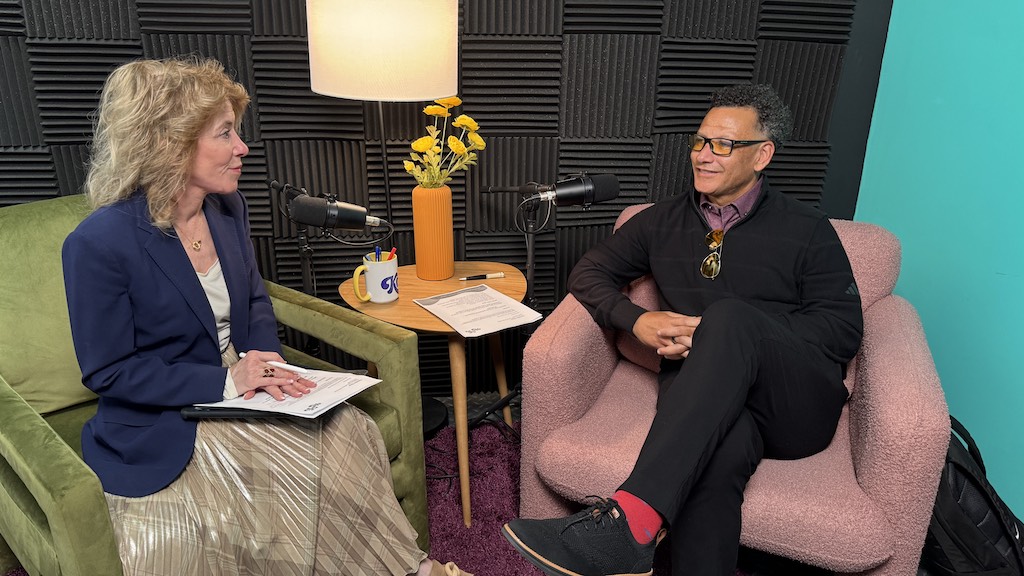
TTR Executive Coaching Founder Derick Brownell
How many people are quietly stuck, unfulfilled, or running on empty at work—even if they look successful on paper?
In this episode of The Knoodle Founders Hour, host Rosaria Cain sits down with Derick Brownell, co-founder of TTR Executive Coaching, to unpack what’s really behind underperformance and burnout—and how leaders can turn it around with a coaching framework that’s both structured and human.
Derick shares the four pillars he and his team use to pinpoint what’s holding people back:
- Technical expertise: Is confidence getting crushed by imposter phenomenon?
- Tactical awareness: Are you actually in the role you think you’re in—or serving a different job than you signed up for?
- Energy management: What routines (exercise, spirituality, habits) restore confidence and performance—and what drains it?
- Social + cultural behaviors: How workplace norms and relationships impact engagement, resilience, and results
Rosaria and Derick also connect coaching to sales performance and resilience—including why rejection is part of the game, and how routines (like athletes use) help people come back stronger after failure.
You’ll hear:
- Why “skills” often aren’t the real problem—and what is
- How to build routines that boost confidence and execution
- What coaching uncovers that leaders don’t always expect
- The mindset shift that helps people perform in tough business climates
- A personal, unexpected story about identity, adoption, and self-discovery
If you’re a founder, leader, sales leader, or high performer who feels stuck—or you manage people who are—this episode will give you a clear, actionable way to diagnose what’s happening and move forward.
Full Transcript
Rosaria Cain 00:00
Good morning. We’re here with Derick Brownell, welcome Derick. Thank you so much for coming and stopping by.
Derick Brownell 00:05
Thank you so much Rosaria for having me.
Rosaria Cain 00:08
Lost, stuck and unfulfilled. Wow, that’s a mouthful. So tell me, how many people in the workforce would you say fit that criteria right now?
Derick Brownell 00:19
Yeah, it’s a great question. Rosaria, you know, when, when Ellie and I kind of put together TTR Executive Coaching, we looked at, kind of, you know, where are people looking for for jobs? So we kind of looked at LinkedIn, right? What are the jobs out there? And then we started talking to people, I would say that everybody is dealing with some type of unfulfillment in the roles that they’re in today, and whether they’re aware of them, or whether they could use a little bit of guidance on how to become aware of them. I think everybody does, but I think even myself, you know, has some of that. So I would say everybody within the workforce has some level of being stuck and needing some support.
Rosaria Cain 01:06
So what do you do for support? What what do you advise as someone that deals with this every day?
Derick Brownell 01:12
So I think the first and foremost is understanding where it’s coming from, right? Where is that sense of unfulfillment or being stuck. Where does it come from? Right? And, you know, with with TTR and the kind of where we’ve found it is to create awareness around technical expertise, right? Is it coming from a state of imposter phenomenon where you’re worried more about whether or not you even have the skills, right, to do what you need to do. The second is tactical, right? Tactical. Where do I sit in the organization? Am I sitting in a place where I was told one thing, one role, and I’m actually serving a different role and and that doesn’t feel comfortable for me, or I am in a role where I want to go forward, I want to climb the ladder, or I want to go in a different direction. What is the tactical awareness, and is that the source of maybe unfulfillment? And then there’s, there’s energy, right? Where, what drives and drains my energy? Are there behaviors in the workforce that are draining my energy, right? Are there behaviors that I can promote, though, am I in an environment where, where people that I’m working with are behaving in ways that I can promote, right? That’s what we all want at the end of the day, and then we can follow along, and then social, cultural, right? Those, those behaviors that drive your energy, where are those coming from and is there something that that I can do, right, to create awareness within the organization, from a cultural perspective, to to drive that positive behavior and engagement?
Rosaria Cain 02:52
So who needs coaching? Is it everyone needs coaching? Or everyone, everyone needs coaching sometimes?
Derick Brownell 02:59
I like what you just said, everyone needs coaching. Sometimes. I think everyone should be aware of what coaching can do for them. It is a bit rigorous, and it’s something to fit into your schedule, but I think that the most important thing is to be aware of what coaching can do for you and that it is something different than a than a psychologist or a manager or a leader, it’s really something intimate for you that helps you to progress beyond some of the challenges that you have.
Rosaria Cain 03:33
So what does coaching do? Tell me I have never been coached.
Derick Brownell 03:37
So, as somebody who has actually become more aware of the need for coaching, as I’ve coached people, is that coaching helps you to understand that you have a relationship with somebody that can help you in the moment. Coaching really takes a situation where somebody is actively doing something, and obviously we relate it to sports, right? Michael Jordan’s gonna, you know, slam the ball, right? He’s a professional. As a professional, you need somebody to run the game by you, whatever your game is, right? So if you’re an executive marketing person, and you’ve had an interaction with somebody that just didn’t come out the way you wanted it to come out. What a coach can do is rewind in the moment, find out where it was that maybe it lost track, and put you on a path to then re imagine and re experience that again in a new way, with different techniques, right? And then to play that back. In some cases, coaches can actually come alongside executives and coach them in the moment, right? That’s advanced, advanced coaching. But for the most part, what it can do for you is help your engagement in the moment.
Rosaria Cain 05:02
Now that’s interesting. It almost sounds like flashbacks. So you so you relive the moment, and then you correct what, where maybe it went awry or off course.
Derick Brownell 05:15
Yes, it becomes a response, and that response becomes kind of trained. One example I can give you, I was grading papers. I do a course, a virtual course, for Yavapai College, and it’s on project management, and it’s the project management kind of advanced class. So what I’ve built into this is a layering of education around project management, and then really get into like, the breakdown of what project management does, some real organization expertise to real world. And so the biggest eye opening piece of that course for most of the students, is the feasibility study, and it’s breaking down the aspects of what the project is supposed to accomplish. And most of the students say, “Wow, if I ever knew right about a feasibility study and the depth of a feasibility I would do that every single time before I ever run a project, because it’s so important”, and it was like a golden nugget, because that’s how executive coaching works, right? Is that you kind of set up the feasibility. You set up what is this person trying to accomplish? Are they aware of what they want to accomplish? And then we can kind of take through the program, right, and validate against what they’re trying to accomplish. And so the feasibility was a funny word.
Derick Brownell 05:15
And you practice that correction as a response versus a reaction. So you now take snippets with your coach and you practice them. So this is really great. They do a lot with sales and coaching, right? Because sales is really that, “hey, do I know what I’m talking about?” Right? Technical, tactically? Do I know where that person is in the company? Are the questions I am asking them, questions they can even answer, right? And then energy? How do I create energy in the moment, right? So that there’s engagement, and then Am I aligned socially and culturally, with that person? So coaching really helps you to practice all those things in maybe a minute or two minutes before you actually do it, and then to reflect. So you talked about flashbacks. We like to do reflections, and what we like to do is map out what it is we expect to accomplish. And then once we’ve done the activities, we want to start off with a reflection, and we want to reflect on what actually happened during those activities, and what can we promote? What was successful about that set of activities, we always want to start with the success piece, because that’s what nobody starts with, right? Everybody starts with, I didn’t do this, I didn’t do that. I didn’t Well, there’s a reason why you didn’t do it, but let’s celebrate the accomplishments of that plan and then set up the next phase of accomplishments with things that you can actually achieve.
Rosaria Cain 05:38
It sounds very official, like something they do in water consumption.
Derick Brownell 05:38
So do it on yourself. You know, like, like feasibility for a person, right? Versus like, land or oil or water, right?
Rosaria Cain 05:38
So the question you’re asking is, what’s feasible, or what can I expect in this, in this level of conversation, what do I want out of it as an outcome?
Rosaria Cain 06:03
So, do people get better at it? With practice, is that the is that the idea, it’s like muscle memory, people practice it and then they do it naturally when they’re in the middle of a conversation?
Derick Brownell 08:48
Is it reasonable? Yeah, you shoot for the stars, right? And you want to shoot for the stars like you really want to. And then you get tested with certain limits, right to whether it’s your technical or skill sets or different pieces or or your environment, but, you want to explore those in a safe space, right with someone who can guide you through where those ceilings are hitting, if you will.
Rosaria Cain 09:17
So I imagine there’s several different approaches to coaching. Tell me what your approach is, or TTR’s, or Axway’s, tell me a little bit more about that.
Derick Brownell 09:28
Yeah, you know it really depends on the experiences coming in. So like you said, you’ve never been coached before, but you’ve probably been on a team before, right?
Rosaria Cain 09:44
Vistage, I’ve done Vistage.
Derick Brownell 09:45
Vistage, yes, other types of group building experiences. So my approach, and this is more of, I would say, a personal approach, and it kind of sinks in with those other leaders or mentors that I work with. Is that we really look at the past experiences of the individual, we look at the past experiences of the team, and we try to bring those together, right? We try to bring together. What are those past experiences that are promotable? Right? That had behaviors that were promotable. And what we mean by promotable behaviors are, like, kudos, right? Like, yeah, Rosaria did a great job with that presentation. We want to make sure that everybody that feels that that is something that’s part of their culture as part of Rosaria’s team, feels engaged to recognize it, right? And so recognition of of of the effort and the outcomes is huge. And so I would say, like there’s so many different approaches, but when you really take the time to customize the approach to the experiences of the individuals and the team and work both of them separately and then together, you get the most outcome.
Rosaria Cain 11:06
What misconceptions do people have about coaching?
Derick Brownell 11:10
Well, I think the biggest misconception is that the coach is going to do the work for them, or that the coach actually understands what work they need to do.
Rosaria Cain 11:23
So there’s work. And so… as I pay you to coach me, there’s work involved.
Derick Brownell 11:31
Lots of work involved.
Rosaria Cain 11:32
Lots of work.
Derick Brownell 11:33
Yes, lots of work. And guess what? Neither person knows exactly what that work entails until you start the initial conversation.
Rosaria Cain 11:46
Okay, so it’s a process.
Derick Brownell 11:47
It’s a process, it’s an absolute process. So for example, we were coaching this car dealership, and we had 43 people within the organization at all different levels and so, you know, you hear about a role, you hear some background about the person, and then you’re coaching them. And so one of the key things that we noticed right away was that less and less of the performance within their job had to do with their actual skills at the job, their role, or any of that it had to do with their energy. And for each person, it was a little bit different. But what it kind of boiled down to was they didn’t have a routine that gave them confidence and energy. And so once they had a routine for exercise and for spirituality and for the things from the energy perspective, their performance started going up, and they started now tackling skill tasks and things that could make them even better in their job.
Rosaria Cain 12:56
Now that’s an interesting concept. Talk to me more about routine so is it kind of like a professional athlete that has all of these routines and rituals,
Derick Brownell 13:09
Right…
Rosaria Cain 13:09
that they do before a big game? For instance,
Derick Brownell 13:11
Yes.
Rosaria Cain 13:12
Is it like that before, before a sales call? Or yes, me through that.
Derick Brownell 13:16
Very similar. So I’m glad you brought that up so each and every person has a kind of a routine or a habit that they go through, whether they’re aware of it or not. And a lot of times what they do physically before and after an activity is really telling about how well they’re going to do it the next time. So for example, like Steph Curry, or, you know, these, these super basketball guys, Steve Nash, those guys, they have a tremendous routine for waking up and and executing on the the technical tasks that they need to do to perform. Right then they go perform. And like anybody who has ever played sports, fail at 99% of it, right? And the 1% keeps them there, but they fail at 99% so what’s really important is, when they do fail, what do they do next? Like, what do they do? They have the ability to wake up the next day and go ahead and work on those 99.9% things again. And so what does that look like for people, it’s completely different. For each person.
Rosaria Cain 14:34
Is sales like that.
Derick Brownell 14:35
Sales is like that.
Rosaria Cain 14:37
You fail at 99% of it, because I feel like that
Derick Brownell 14:40
99.999% and that’s why we’re doing a lot of like, the inbound leads and bait, right? Like, so instead of, you know, putting it on yourself to to really accept and become resilient at every stage, right, you try to some different techniques. Yes, but you’re right. Sales is a great example, because you have to expect to fail. You can’t practice enough not to
Rosaria Cain 15:08
Well, that fear of rejection is what keeps us from loving it so much, right?
Derick Brownell 15:13
But then when you do succeed, you try to repeat, the success of that sale or that deal. And in doing so, it’s a good practice, but you have to know that it’s like every game is different. You have different opponents. You have different personalities within the next deal that may throw it off. So it’s that continuous influences, you know, cultural norms, standards, things like that. So I think that you know, part of getting back to kind of the quality of coaching is that organizing your mind for resiliency, but also for understanding that you’re continuously learning and having somebody kind of there to support that continuous learning through success. Right? Sometimes we succeed, and I’ll give you a good example of this. Sometimes we succeed, and then we’re like, well, now I’ve done everything I need to do, right? So now I’m going to take a long break. When I first started at Axway, and this story is kind of funny, and it’s one that I can share, I found a product that we sell, that I could exponentiate, I could sell it and retire quota quickly. And so I sold, I sold it in the first quarter, and was at 75% of my quota in the first quarter, right? As an as a net new salesperson, that’s a great way to start, you know, and, and so I got on the calls with the with the executives, with with our team. That great, great job. Now, what are you going to do next? Right? And I thought, Well, my mindset, I’m, like, a program project manager. I’m like, Okay, I’ve got it all set up, like, I’ve got all the things I want to accomplish through the end of the year. But I’ve never been, you know, I’ve never had that conversation where they’re like, Well, you don’t really have to do anything for like, three months or whatever, however, but we want you to continue to be active, because, I guess a lot of sales folks, and again, I haven’t been exposed, but if you get that far, that fast, you have the tendency to just relax, right?
Rosaria Cain 17:31
Is it equivalent of Michael Jordan saying he’s going to Disneyland after his NBA final run?
Derick Brownell 17:40
And so I think, you know, it’s funny, you don’t want to relax too much, right? You want to enjoy your successes. And then kind of, what’s next, right? What do I how do I keep that next thing in mind? Because some of the people in the coaching journey that that, that my partner and I have worked with, have really achieved their 90 day goals in 30 days.
Rosaria Cain 18:04
So it’s almost a time of reflection, yes, and kind of a reboot, yeah, or reset, okay, that makes sense. Now we’re in some interesting times. Business climate is a little bit different than it’s been. Political climate is off the rails. Which is driving, I think business climate, is this a good time for coaching, or is it not a good time for coaching? Or, how does a business climate affect what goes into what you do and what people get out of it?
Derick Brownell 18:40
That’s a great question, because I think as people start to think about, why, why am I in the career I’m in, or why am I doing the things I’m doing each day, are they motivated by the information I’m taking in? Right? And if, if, if my actions or activities are motivated by what I’m taking in, whether it be politically or at my job or whatever, is that helping me? Right? Is that helping me achieve my goals? So I think now is more it’s more important time than ever to have somebody that is helping you to have that conversation around, what am I taking in, what am I putting out, and is it helping me? And those are the three things that I think, you know, inputs, outputs, and value.
Rosaria Cain 19:35
So watch the news. Don’t watch the news.
Derick Brownell 19:37
Yeah, and consume it, knowing that you can have a conversation with somebody on whether or not what I’m taking in, is actually coming out in a positive way, or in a way that’s going to accelerate. We like to call this all the time, accelerate my personal goals, right? And what I want to accomplish. And to your point, like, it’s really a daily thing. Now, I’m not saying you have to be coached daily, but if you’re aware of coaching, and you meet with a coach every seven to 14 days, you’re taking in so much information in between that there’s a lot to reflect on and there’s a lot to optimize. Now, one of the things that became super apparent in the last 24 months is that people have to reflect more often. So back in the days, right? I want to say super back in the day, so you just didn’t have so much content coming into you, so you could take your time with the content that that was coming in. And you would say, maybe a reflection every 30 days or quarter or half a year. What we’ve noticed in our what I’ve seen in a 90 day program, where you’re really trying to make some significant change in 90 days, or you’re you’re trying to evolve something in 90 days, which is really a good time frame, to give yourself human time frame, not tomorrow, not the next day, not seven days.
Rosaria Cain 21:15
So 90 days is a good Bellwether.
Derick Brownell 21:17
Great Bellwether, for significant opportunity to change some things, right? And so what we noticed, and in the program, the way we were setting it up, was that we would have a real deep dive, get into the 90 days, you know, find out feasibly, what what you can accomplish, what the tasks are activities. And then we’d set up seven day, 14 day, 20 day, 30 day 60 day, and then a 90 day coaching session, right? And what we found, what was interesting about that approach was that as we became closer to closer to all of the content being forced to you in different channels that seven days was was too long. It was too long to have that much reflection on what you were doing,
Rosaria Cain 21:19
Because the news is instantaneous now on your phone every seven seconds.
Derick Brownell 22:15
Yes, so, so we really needed to at least have the buffer, because you think you can do a lot more than you can do in a short period of time, but you can accomplish a lot more than you think you can accomplish in 90 days. So so what we found is people get so upset that they can’t accomplish the things they want to accomplish in the short period that they kind of need somebody to help them see the light at the end of the tunnel right in the 90 days and keep on track. And maybe some of the things change, right? But they change in a way that then modifies that 90 days, and people end up doing things they thought they couldn’t do in 30 or 60 days than in 90 days. But that focus on the fact that you have so many inputs you are outputting more than. I mean, people work more than they’ve ever worked nowadays, right? Like it can work multiple jobs or multiple things. So they’re working more they’re outputting. But how many of them are having value conversations about what they actually did and how that leads to an overall success plan at the end of the day?
Rosaria Cain 23:33
That’s interesting. So have you always had this entrepreneurial mindset?
Derick Brownell 23:38
I would say, No, really.
Rosaria Cain 23:43
When did you, get the bug to be an entrepreneur, like when you founded your company? And I guess in when you’re in sales, you’re always an entrepreneur, really, because you’re really in your own business, and you sink or swim, depending on your as you put it, output.
Derick Brownell 23:59
And I think the answer to that is, really, at the end of the day, it’s, it goes into sports, it’s kind of like, hey, you’ve got something, right? You you’re doing something that somebody sees as solves a problem, right? So Young, when I was younger, and I was playing soccer at a young age, I was fast. I was faster than a lot of people. So coaches were like, Wow, he’s fast. Let’s get him on our team, right? So where does that go? You know, later on down. So people see something in you, and they put you in the position,
Rosaria Cain 24:36
and you’re still doing the shock and awe, right? Because you meet your goal like your first weekend, yeah.
Derick Brownell 24:42
So I try to figure out what it is that that try to figure out what the problem is, and I try to solve it. And so my business partner for TTR, Elli Tava, we were at a sales training and for slalom in Seattle, 77 people, yeah. Huge training. We’re sat at the same table. Never met her before. She’s out of New York. We start talking outside of the conference, just having conversations. And we talk about, like, my background in coaching soccer and kind of being an advisor, right? You know, business advisor, like I’ve done consult, a lot of consulting work, and in my approach, right? And I’ve always taken an approach that’s like a real kind of, I would say, a servant leader approach, or kind of a, you know, “I need to know you almost like a player” centric or a individual centric approach. I try not to force my own experiences on the situation. And she said, “Wow, you know, I’ve been looking at executive coaching and the formal executive coaching, but what you’re doing with four pillars of performance and taking kind of a scorecard of performance and applying it to coaching and giving it a timeframe, let’s say 90 days or 30 days. That’s what’s missing. I said, Wow. Okay, so two years later, she said, why don’t we start a company? Why don’t we do it together and start a company and bring those two pieces together to solve a problem? And so that really, I think, for most people who have founded a company, have found a way to solve a problem, right? That, that maybe, you know, can create benefit for somebody
Rosaria Cain 26:35
Well, but there are highs and lows in this in this arena, correct, right? Tell me about some of the highs and lows.
Derick Brownell 26:41
So the high high is, is that realization with the person you’re coaching, or the company you’re coaching, that what you’re doing is creating awareness, and that the awareness is leading to different behavior, and that different behavior is leading to success and like, let’s say more car sales for the car dealership. And you see that the low, low is that, in many cases, as a coach, you’re uncovering things that were unexpected during the conversation and they’re tough. I mean, they’re tough and, but people want to perform, so they’re honest with you. They say, this is it like I had these things happen to me in my life, and they’re they’re preventing me, on a day to day basis, in the moment, from performing. And as a coach, you’re not a psychologist, and you’re definitely not a counselor. And so you kind of have to then unpack those things that you’ve heard, because they’re not things that you’ve dealt with, whether it be an addiction or something like that. And so what it’s a low, low, but what I like to call it as is, it’s a you become resilient, and you start to rebound, and the rebound activities, for a coach that hears some of those things, is to have a coach, another coach. So many times…
Rosaria Cain 28:05
So does a coach, have a coach, have a coach?
Derick Brownell 28:10
I don’t know how many layers deep it would go, but definitely you look at it though, like, if you did say, like football, like, right? You have a head coach, you have a defensive coach, you have a offensive coach, you have a special teams coach, right? So you can apply that to your life, right? You can say, like, look, I need a trainer that’s a coach to increase my exercise, right? And with executive coaching, really, the focus is that awareness of of where you may need that expertise, right? And so in some cases, a lot of cases, when I’m reflecting back on a session and I have a coach that’s helping me reflect back on that session, they’ll help unlock ways that I can depersonalize it. You know what I’ve heard,
Rosaria Cain 29:05
That’s the same thing you were talking about. So you reflect on it, on how you might have done it differently, or is it just to relieve yourself of having it carried around in your head, both?
Derick Brownell 29:17
Both. But that what you just mentioned, that that carrying around in your head, so many people are doing that, and in the executive coaching arena, when you’re coaching people, it’s so important to have those conversations. I think in sports, it’s easy, but when it’s really affecting someone’s performance for their their life, their day to day, and that’s where the coach comes in, that day to day, having that reflection, to relieve it, and then have someone that you can ask questions of, that can then ask you additional questions to come to that release, if you will. I love the way that you said that Rosaria, like you’re. carrying it around with you, yeah, you’re carrying it around. And it can either be, it’s a barrier, right, and it could be heavy, or it could be something that creates light, and it creates an awareness in the coach that then they can bring to that person. And in a reflection, say, “I reflected on that, and tell me a little bit more about how it impacts you on a day to day basis”, and just having that conversation, being able to then address it again without fear and and help that person get through it. It’s It then starts to take that off your shoulders, but you kind of need some help to to practice that, to get there, to even, even again, initiate it, because it just like anything like, I think we can all admit there’s certain things we procrastinate on, and the reason why we may procrastinate on it could come in many different forms, but when you have a coach, It’s really hard to procrastinate, because what they’re going to do is ask you about what it would do for you if you actually did it right. So what would it do for you, Derick, if you actually address that concern or that roadblock with that person, even though it’s uncomfortable for you, what would it do for you? And the answer to that question is kind of what I explained to you, but having someone ask that and have you verbally articulate it, it, it unlocks a lot.
Rosaria Cain 31:30
So as you’re going through this and you’re talking about what makes a good coach, what comes in, what goes out, what makes a good leader, are they the same thing? What makes a good leader, and what makes a good coach? Or are they different? The characteristics,
Derick Brownell 31:44
The characteristics are very similar and and when you deep dive down into leadership versus coaching, I think leadership is something that includes the skill set of coaching, I think, as a great leader, you would adopt some of the skills of a leader, some of the skills of a teacher, some of the skills of, I wouldn’t say manager, but you, you kind of adopt the skills that are inherent in those and that kind of gives you that leader piece. And then when you break down, like, hey, as a coach, a leader could be but usually the coach is saying that skill set of leadership is kind of a formation of a number of different things. That person is going to give you a lot of different pieces, and I think that that it’s really based on different on on people’s experiences, how they then interpret that, right? Should a leader have coaching skills? I would say yes, for sure. Should a leader have teaching skills? Yes, they should. Should a teacher have coaching skills? Maybe, maybe not. Depends on the situation. But I think you have to kind of break those out in order to see what the quality is, what the value is. So if the leader is leading, and they’re and they’re successful, what components of that success are broken down into, how they’re teaching their teams, or how they’re coaching their teams, right? And can you break those down? Can you separate the values? But I think there are different, different characteristics, and they show themselves in the value that you get out of the experience most people after they go through their first executive coaching session, which I’d love to do on with you at some point, the awareness of what it can do for you is just different for different people, and I think it leads to it to it leads to an understanding of, okay, you know, now I have this new skill set, right? And a lot of times when you’re coaching somebody, they end up adopting coaching skills in their own life.
Rosaria Cain 34:16
Is coaching kind of getting out of yourself and looking at yourself as an observer?
Derick Brownell 34:23
Yes, yeah, you really have to take, I would say, kind of your ego out, your own assumptions have to go away, and you really have to get towards: what does success look like for me? Like you mentioned Michael Jordan, like, if you could get into his mind, you could only imagine what success must have had to look like for him in order for him to achieve what he achieved.
Rosaria Cain 34:55
But then he went into baseball.
Derick Brownell 34:57
Yeah.
Rosaria Cain 34:58
Not so much.
Derick Brownell 34:59
Not as successful.
Rosaria Cain 35:00
He wasn’t successful at everything.
Derick Brownell 35:02
I think that the skill sets didn’t match up right. And sometimes, you know, this is the other piece that’s really fun about coaching, is that sometimes you just realize, hey, what I thought I wanted to do really…
Rosaria Cain 35:16
I wasn’t good at it.
Derick Brownell 35:17
Yeah, it wasn’t, not good at it. It’s not and this is the funny thing about youth sports, is like, you know, I see so many great things about the kids. And I would say 50/50, the parents are totally understanding of that. And like, yeah, it’s a journey, you know, develop. And then 50% are just like, they want to play division one, they want to do this, they want to do that, and they want to be pro.
Rosaria Cain 35:41
That’s probably the hardest part of coaching, I imagine, is working with parents. Kids are fine.
Derick Brownell 35:46
You become a counselor.
Rosaria Cain 35:47
Yeah.
Derick Brownell 35:47
The kids, the kids just want to hang out with their friends, I mean, at the end of the day and sometimes they realize they’ve got talent that that is, is is really at a different level than some other kids, and so, you know, you want to help them with that talent and help them mature it and help them be successful with it, but, but, yeah, the parents are fun. Parents are a lot of fun.
Rosaria Cain 36:11
Is part of it letting them know that they don’t have maybe quite as much talent as other kids? Or do you get those questions?
Derick Brownell 36:20
I think it’s more like how they feel about themselves, right?
Rosaria Cain 36:26
Yeah, so the parents maybe have those aspirations,
Derick Brownell 36:29
Right.
Rosaria Cain 36:29
But the kids are more grounded.
Derick Brownell 36:31
The parents, and even myself included, you absolutely just see way too much, right? You want them to do all these things you want them to be successful. So you kind of like, like, Tommy Boy is, like, you got this little, you know, muffin, and you just, like, crumple it all up. I think that parents, they want the best for their kids, but they just, they just don’t know how to separate, like, like, you know. And so the counseling is more of like, what can you as a parent be valuable for? Well, the basics, right? Food, you know, education, transportation, those are the things you can be an expert at, right? So, like, it’s know your role and and that kind of thing. But the kids, I think, they be they, they have different realizations. And so those, they’re open, they’re honest, they’re like, “I can’t juggle very well”. All right, let’s put a plan together to help you juggle, or let’s do this skill set or whatever. When you take, you know, some of the external influences out, it just becomes a matter of time, right timing, and things like that.
Rosaria Cain 37:40
So you mentioned family. I imagine that’s a lot of what keeps you grounded.
Derick Brownell 37:43
Yes, yes.
Rosaria Cain 37:46
What other things keep you grounded? What kind of habits and activities do you do to kind of get your mind off of work so that you’re not always thinking about your coaching and replaying your conversations, or your clients conversations?
Derick Brownell 38:00
Yeah, yeah. So well, I love, I love, love, love selling. And then obviously we talked a little bit like, I love to coach. I love selling and finding out how to solve problems for my clients. But in my downtime, you know, I love to travel. And I was just really fortunate to we had our kickoff for Axway in Caen, in the south of France, and so I got to kind of blend in.
Rosaria Cain 38:26
That’s rough. That’s really miserable.
Derick Brownell 38:29
Well, it wasn’t the best season. It was a little chilly there, but it was, it was wonderful. I would say the thing that kind of helps me a lot is like leaning into great team. So the team there, from all of the executive team all the way down, we did a full two days of B to B sales training. I loved it. I mean, again, I just love the fact that we spent the time together.
Rosaria Cain 38:58
Well you’re in Caen. You’re doing sales training.
Derick Brownell 39:00
Yeah.
Rosaria Cain 39:01
What’s wrong with that Derick?
Derick Brownell 39:03
And some of it, like had coaching elements and leadership elements and all this, and we’re running down the beach and all this stuff. And so I love to travel, and so I lean, I’m trying more and more and more to lean into invitations that I get. So right after Caen, we ended on the 16th of January, and I have some friends that started a soccer club in Hawaii, and they had an opening-
Rosaria Cain 39:31
All the worst places you go to the most awful places on Earth.
Derick Brownell 39:37
And so they had a tournament over 50s tournament, and they wanted to bring in some guys. And so I committed. And so I flew from Nice to London, London to LA, LA to Honolulu. And I got to Honolulu, and it was, must have been as a Friday at like nine o’clock at night, and there were 1000s of people. People on the street in downtown Waikiki. I’ve stayed in Waikiki, and I just couldn’t believe, like, how many people were out at nine o’clock at night. And then I realized, as I was there for five days, that it never got below 61 degrees and never got above 68 degrees.
Rosaria Cain 40:17
And generally, some of us are asleep by nine o’clock at night. So we never no who’s out in the street.
Derick Brownell 40:22
Yeah, so I was like, I was so surprised. I got in a little bit late, but I left Nice at 7:30 and I got in at nine-something. But I love the entire I think, to answer your question, I love to travel and really lean into opportunities to be with friends and and family and those kinds of things. It’s kind of a hobby.
Rosaria Cain 40:43
If you were going to write a book, what would you call it?
Derick Brownell 40:47
Oh, my goodness, that’s a great question. If I was to write a book, I don’t know.What would I call the book? A journey. I would just it would have to have something with a like a journey, maybe, maybe The Derick Project, or something like that.
Rosaria Cain 41:09
We’re all a work in progress. I hear you there. What fact would surprise people about you?
Derick Brownell 41:19
Interesting question. Yeah. So a lot of people think that I may be from, like, a foreign country. So people like if I’m In Miami, people speak Spanish to me right away. If I’m in New York, people think I’m Dominican if I’m in Phoenix, you know, it’s different, right? Wherever I go before I speak to them, they have a premonition. But I recently was, in last five years, I was adopted, and so I really didn’t know. So I did 23andMe and I found out that I’m half Polish and English and half African Nigerian and so on my birth certificate, it’s Derick Brownell, but my actual name would have been Derick Jankowski,
Rosaria Cain 42:01
Polish and Nigerian.
Derick Brownell 42:02
Yes,
Rosaria Cain 42:03
Who would’ve guessed. Well, that’s why people do it, I guess.
Derick Brownell 42:06
Yes.
Rosaria Cain 42:07
Well, this has been a great conversation. I appreciate the time you’ve spent with us today and all the insights regarding coaching. Thank you so much for coming.
Derick Brownell 42:15
Thank you, Rosaria. I appreciate your time, and thank you.